Best Materials for a Long-Lasting Backyard Patio in Any Climate
Best materials long lasting is an important consideration for homeowners, and this guide covers it in detail. A backyard patio is one of the highest-return outdoor investments a homeowner can make, but its lifespan hinges almost entirely on one decision: the material you build it with. Choose poorly and you’ll face cracking, heaving, fading, and costly repairs within a few seasons. Choose well and your patio can look sharp for 25 years or more, whether you’re baking under an Arizona sun or riding out freeze-thaw cycles in the Midlands or the Midwest.
This guide breaks down the best patio materials for durability across every climate, what each realistically costs in 2026, and how to match a surface to your specific weather challenges.
Table of Contents
What “Long-Lasting” Actually Means for a Patio
Durability isn’t a single property. A material that survives desert heat may crumble under repeated freezing. When evaluating any patio surface, weigh four factors:
- Freeze-thaw resistance – the ability to shrug off water that expands as it freezes inside pores and joints.
- UV and heat stability – resistance to fading, softening, and thermal cracking.
- Moisture behavior – how the material handles standing water, humidity, and drainage.
- Structural stability – resistance to shifting, settling, and root or soil movement.
The best material for you is the one that scores highest on the challenges your climate actually throws at it.
Concrete: The Versatile Workhorse
Poured concrete remains the most popular patio material in North America for good reason: it’s affordable, moldable, and lasts 25-30 years when installed correctly. Expect to pay $8-$18 per square foot for a basic broom-finished slab in 2026, rising to $15-$28 for stamped or colored finishes.
Concrete’s weakness is cracking. In freeze-thaw climates, insist on proper control joints, a compacted gravel base, and air-entrained concrete rated for your region. In hot climates, a lighter color reduces surface temperature and thermal stress. Sealing every two to three years dramatically extends its life anywhere, and a fiber-reinforced or fiber-mesh mix adds meaningful crack resistance for a modest premium.
Natural Stone: Premium Longevity
Flagstone, bluestone, travertine, and granite pavers are the gold standard for lifespan – a properly set stone patio can outlast the house. Costs run $20-$45 per square foot installed, with exotic stones climbing higher.
Matching Stone to Climate
- Cold, wet regions: Dense stones like granite and quality bluestone resist freeze-thaw damage. Avoid porous limestone unless sealed.
- Hot regions: Travertine stays remarkably cool underfoot and reflects heat, making it a favorite in the Southwest and Mediterranean climates.
Set stone on a mortar bed or a deep, well-draining aggregate base to prevent shifting, and choose a thickness rated for foot traffic and your regional frost depth.
Porcelain Pavers: The Modern Overachiever
Outdoor porcelain pavers (typically 20mm thick) have surged in popularity because they’re nearly indestructible. They absorb almost no water – often under 0.5% – which makes them exceptionally freeze-thaw resistant. They don’t fade in UV, resist stains, and never need sealing.
Budget $15-$30 per square foot installed. Their only real drawbacks are a higher upfront cost than concrete and the need for precise installation, since the tiles are rigid and unforgiving of an uneven base.
Brick Pavers: Classic and Climate-Friendly
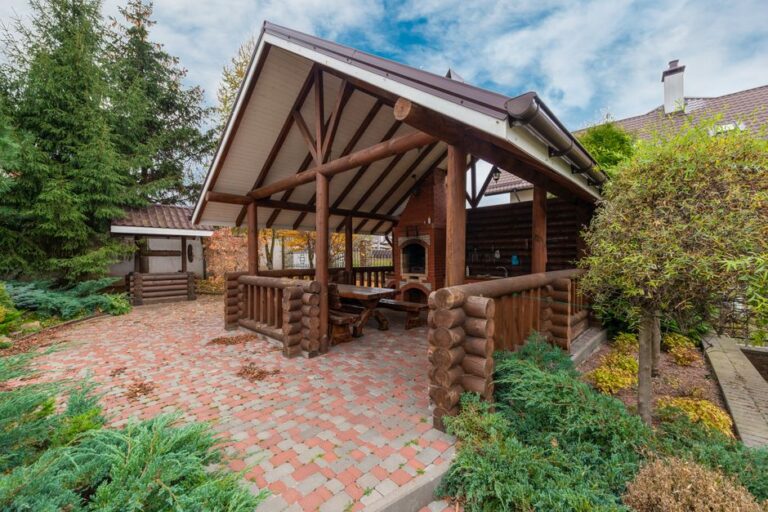
Clay brick pavers deliver timeless looks and genuine longevity – 25 to 50 years – while handling both heat and cold well. Because they’re installed as individual units over a flexible sand-and-gravel base, they flex with ground movement instead of cracking like a monolithic slab.
Expect $12-$25 per square foot installed. Occasional re-leveling and joint sand replenishment are the main maintenance tasks. Choose “severe weather” (SW) rated brick in freeze-prone areas.
Concrete Pavers: The Balanced Choice
Interlocking concrete pavers combine much of brick’s flexibility with lower cost and more design variety. At $10-$22 per square foot installed, they’re a strong middle option. The segmented design means a cracked unit can be swapped individually, and the flexible base resists frost heave better than a poured slab.
Look for pavers with a high compressive strength rating (8,000+ psi) and low absorption for the best cold-climate performance.
Materials to Approach With Caution
- Poured pea gravel or loose aggregate: Cheap and permeable, but high-maintenance and prone to migration.
- Wood decking at grade: Beautiful but vulnerable to rot and insects when in ground contact; better raised.
- Untreated or unsealed limestone/sandstone: Attractive but porous – a liability in freeze-thaw regions.
Climate-Specific Recommendations
Cold and Freeze-Thaw Climates
Prioritize low water absorption and flexibility: porcelain pavers, dense granite, SW-rated brick, or concrete pavers on a deep, well-drained base. Drainage is everything – standing water is the real enemy.
Hot and Arid Climates
Focus on heat reflection and UV stability: travertine, light-colored concrete, or porcelain. Cooler surface temperatures also mean a more usable patio in summer.
Humid and Coastal Climates
Fight mold, moisture, and salt: porcelain and sealed dense stone excel. Ensure grading directs water away and consider a permeable joint system for drainage.
The Bottom Line: Invest in the Base, Not Just the Surface
The single biggest predictor of patio longevity isn’t the material – it’s the foundation beneath it. A premium stone patio on a poorly compacted base will fail faster than budget concrete pavers on a properly built one. Insist on adequate excavation, a compacted aggregate sub-base, proper grading for drainage, and edge restraints.
For most homeowners seeking maximum lifespan with minimal maintenance, porcelain pavers and dense natural stone lead the field. For balancing cost and durability, concrete or brick pavers are hard to beat. Whatever you choose, match it honestly to your climate and build it on a base that will last as long as the surface – and your patio will reward you for decades.